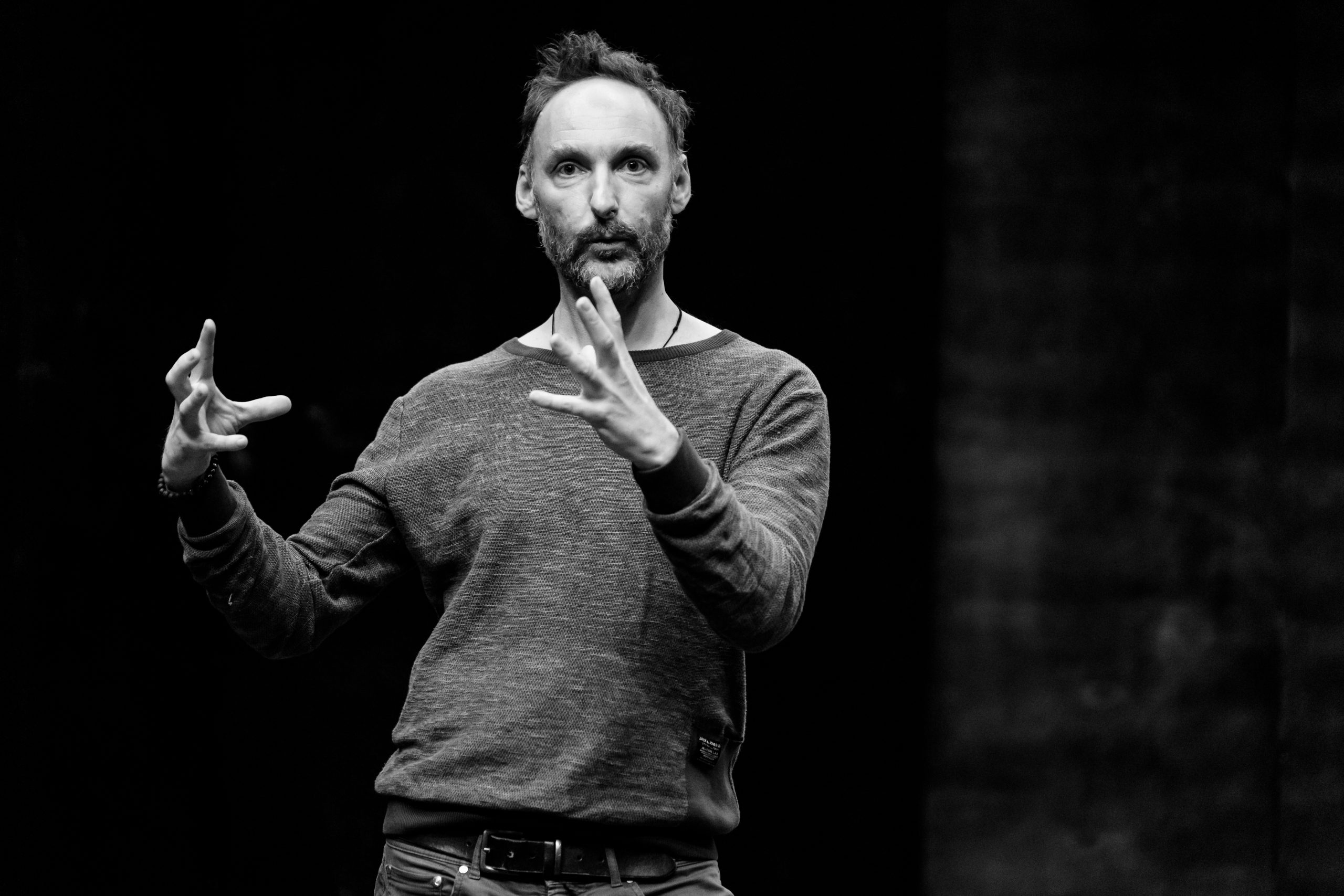

Hello, I’m Clément Layes. I am a choreographer, dancer, and somatic researcher, born in France in
1978. Over the past 20 years, I have created a body of performances that invite reflection on non-
human agency and articulate new visions for a world with dance at its center. Since 2008, I have
produced my own work and developed event and residency programs in Berlin. My work has been
presented at some of the most prestigious venues in Europe and the Americas. Below you will find
details about my background and activities.
Education and Training
Clément obtained his Baccalaureate in Economics in 1998. From 1998 to 2000, he studied at the Circus School of Lyon. Between 2000 and 2003, he completed professional training in contemporary dance at the CNR / CNSMD. He studied with outstanding figures of the time, including Xavier Le Roy, Jonathan Burrows, Joseph Nadj, Vera Mantero, and Steve Paxton.Artistic Career
From 2004 to 2010, he worked as a performer and researcher with, among others, Odile Duboc and Boris Charmatz. In 2008, he co-founded Public in Private with Jasna Vinovrski in Berlin. He had his breakthrough as a choreographer with the solo Allege (2010), which was presented at numerous venues and festivals in Germany, across Europe, as well as in Canada and the USA. He received the Jury Prize at the Infant Festival (Novi Sad, Serbia) and was awarded the Prix Jardin d’Europe in 2011. Numerous productions followed, most of them co-produced with Sophiensaele Berlin and various European platforms. In 2018, Clément Layes was invited by the Venice Biennale to present a retrospective of his work. Throughout his career, he has developed a working method that brings choreography, visual art, and conceptual thinking into dialogue through research on everyday objects. This method has been discussed in several publications, most recently in Martina Ruhsam’s Non-Human Bodies in Contemporary Dance, which received the Dance Science Prize NRW in 2021. The following years were marked by significant aesthetic and personal shifts. In 2021, he created Ich bin Tscheud with Jasna L. Vinovrski, a work addressing their family’s process of obtaining German citizenship. In 2022, experiences of loss and the pandemic inspired The River I, a work performed daily on Berlin’s waterways during the summers of 2022 and 2023, and later adapted for the Festival Internacional de Buenos Aires (FIBA) in 2024. clementlayes.comResearch / Grants
Since 2014, Clément has received numerous grants, scholarships, and research stipends from the Berlin Senate, HKF, the Goethe-Institut, and other funding bodies in Germany and abroad. Between 2016 and 2020, he was a recipient of the Basisförderung, a long-term structural funding program awarded to outstanding choreographers. He continued to organize his work through annual funding until 2023, when he decided to undertake an 18-month research period in dance and somatics, supported by Tanzpraxis Berlin and the Berlin Senate.Platforms and Institutions
Since 2014, Clément Layes has critically engaged with theater as a site of artistic presentation, particularly in Berlin. In 2011, he created the PIP Studio, a rehearsal space in Kreuzberg. He co-founded the platform How Do We Work It, which questions the conditions of art production and opens new spaces of possibility. Following this initiative, he and Jasna L. Vinovrski launched the 3AM event series at Flutgraben e.V., involving hundreds of artists and thousands of spectators between 2014 and 2017. Further initiatives followed, including the event series Flutgraben Performances and the Flutgraben Residencies program (2019). Through this work, Public in Private Studio and Flutgraben e.V. have become significant alternative spaces for dance and performance in Berlin. In 2017, he collaborated with Kunstencentrum BUDA (Kortrijk, Belgium) on an accompanying festival program and co-developed the concept of The Fantastic Institution. That same year, he became a co-organizer of The Watch, a group of artists dedicated to the artistic activation of a former border guard tower at Schlesisches Feld in Berlin. flutgrabenperformance.com https://3am.events/Somatics
Since his early dance studies, Clément has been deeply engaged with somatic practices. He encountered leading figures of non-representational and somatic approaches to dance, including Steve Paxton, Hubert Godard, and Claude Espinassier. He completed professional training in the Feldenkrais Method in Basel under the supervision of Julia Casson Rubin and Paul Rubin in 2006. He has also been influenced by the Ericksonian approach and Somatic Experiencing. He has been a Vipassana practitioner since 2011, completing numerous retreats, and since 2018 has practiced the Chöd meditation technique. In 2024, he completed the “Like a Pro” level training in the Wheel of Consent with Betty Martin, as well as the advanced level “Working with Groups” (2026). His trauma-informed approach draws from Somatic Experiencing, numerous workshops, readings, and therapeutic work. He also participated in the seminar Polyvagal Theory and the Modern Family: Finding Safety and Connection with the Polyvagal Institute, featuring researchers such as Gabor Maté and Stephen Porges.Teaching
Clément regularly teaches at universities of the arts and leads workshops internationally. His teaching is grounded in over 20 years of research in performance-making and rooted in an embodied approach to questions of object agency, post-humanism, and phenomenology. His background in dance and circus, informed by somatic practices and a strong interest in philosophy, creates space for curiosity, pleasure, and playfulness. He understands these as essential pathways for students and staff to access their resources, develop creative strategies, and actively engage in the learning process. Through his training in consent practices and trauma-informed education, he creates spaces in which risk and failure can be experienced in a supported and constructive manner. Since 2014, he has worked as a guest lecturer and mentor at HZT – University Center for Dance Berlin and has taught at institutions including the University of Zagreb (Dance and Theatre) and the MA in Physical Performance Making in Tallinn.